Some uncommonly rad neighbors move back to the barn behind our house.
Red foxes are rad. Red foxes have the best Latin-science name. Vulpes vulpes. How rad is that. Do you know how uncommonly rad you have to be to have the same first and last science name? Pretty stinkin’ rad. Red foxes are that rad.
Red foxes are so uncommonly rad because, though a member of the canidae family, they share many characteristics with felines. Rad-ness correlates to cat-ness, is what I’m saying. (Not to be confused with Katniss.) Search your feelings: you know it to be true. Here’s a partial list of the uncommonly rad things that red foxes and cats have in common:
- Vertical slit pupils—super suitable for night vision and judging distances
- Slyly sensitive whiskers for navigating in the dark
- Active at night (see: previous two points)
- Retractable claws for all-around rad-ness and also for climbing trees (I have seen a red fox run up a tree after a squirrel—it was so rad)
- They stalk and pounce on their prey, solo—whereas wolves and other lame canines hunt in packs to chase down their prey
Did you know that red foxes (and other varieties of foxes, just to be clear) use the earth’s magnetic field to locate field mice and other prey hiding under snow or grass? It’s true. This is the most rad thing about red foxes, if you ask me. When foxes align their pounce to the northeast—true magnetic north—their kill rate is 73%. This is called “magnetoreception.” It’s like a rangefinder, but one that only a fox can use.
That is uncommonly rad. Also, that is very cat-like kill rate.1 That is an uncommonly rad kill rate. Have you ever seen your average, slobbering grey wolf or your average, slobbering golden whatever-oodle align their pounce to true magnetic north? Can your dog even pounce? What is your dog even doing with its life if it’s not aligning its pounce to true magnetic north like rad-es rad-es vulpes vulpes? True magnetic north for true fox.
Yeah, science. Yeah, Latin. Yeah, foxes.
If I were to ask any of the uncommonly rad graphic designers I’ve had the privilege of knowing and working with to design a family crest for our household, I’d ask for the incorporation of a fox somewhere in that crest. Maybe the shape of the crest itself is in the shape of a fox head. Like that overpriced outdoor gear brand from Scandinavia.
Why am I talking about foxes and fox-themed family crests? What are we doing here? Why is the title of this post so obviously but immaculately pun-y?
It’s because the foxes are back.
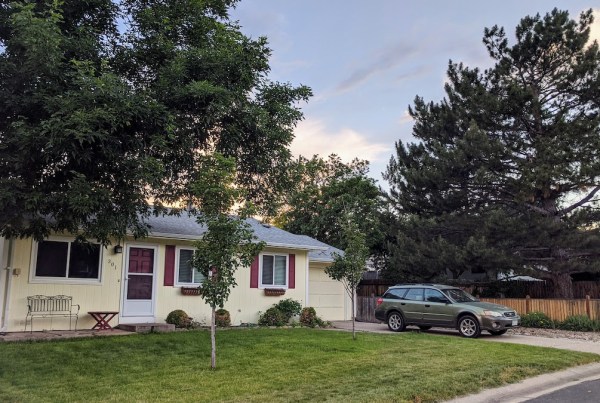
We’ve lived in our current home for four years. Moved in May of 2022. One of the draws of this place was that our lot backed up to a farmstead. A hobby farm smack in the middle of Fort Collins, complete with giant red barn, ponies, horses, goats, and an open field running off to the east. All the esthetics of farm life, none of the responsibility.
Then, in the winter of 2023, a female (vixen) and male (tod) fox couple started checking out the neighborhood2. Throughout January and February, we’d see them a couple times a week, milling about the barnyard (and once even in our backyard). I’d see them on early morning walks along the greenway and out in the fields east of the barn. But as the weather warmed, we saw them almost daily. Sometimes with the carcass of a rabbit dangling lifeless from one of their jaws. Then, in early March, they disappeared. We thought they had moved on. Rent in Fort Collins is ridiculous, you know.
But no. They had dug their whelping den underneath the rear door of the barn—fifty yards and a straight, unobstructed shot from our living room windows. A few weeks later, we saw a mass of tiny gray furballs frolicking on the “front porch” of the whelping den. Six pups.3 How uncommonly rad is that?

And just like that, our family had a new pastime. We did much fox watching from early April to mid June. Lindsey named the kits Rumble, Tumble, Jumble, Bumble, Fumble, and Humble (the runt). We checked out as many fox books as we could from the library, including Roald Dahl’s Fantastic Mr. Fox, which we read with much enjoyment and subversive schadenfreude. That spring, Lindsey perfected a technique by which she’d hold her phone up to binoculars to capture up-close videos of the foxes. I mean, this is Marty Stouffer-level stuff right here:
Our family spent so much time on our sofa, gazing out our living room windows, laughing at the kits as they wrestled with each other, or shaking our heads in wonder at how fast they grew, their fur changing from grey to light orange by the time midsummer approached.
The story repeated itself in the spring of 2024:
- Early February: the vixen and the tod are seen in the barnyard—being cutesy and flirtatious and acting generally jazzed to be with each
- Mid March: Sightings pause; time to give birth underground
- Early to mid April: First kit sightings
- Mid June: The juveniles have grown and gone their own way into fields and suburbs looking for their own place to start a family
We’re not certain if it was the same fox couple from 2024, or if it was one of their offsprings who returned to keep the family tradition going.4

In 2025, family dynamics must have changed, and there was no fox-raising for us to behold that year.
This year, we were hopeful. On January 12, two foxes appeared in the barnyard. They were active and very much in discovery mode. One (presumably the male) left its scent on a fence post in the barnyard. Then it hopped over our fence and sniffed about the backyard for a minute.
A couple weeks later, that same fox came trotting down the actual fence line as I stood in our backyard sipping coffee as the sun was coming up. I was less than 15 yards from it, and it never saw or noticed me.
But the spring came and went without many more sightings, and definitely no mess of kits billowing up from underneath the barn.
I thought our luck was up. But on the morning of April 20, a momma fox with a juvenile kit in tow appeared out of nowhere. They spent the morning refurbishing the “front door” of ye olde whelping den in which the two previous generations had come into the world.5
Someone looks happy to be back at the ancestral home:

We’ve seen them almost every day since. One morning earlier this week, as Lindsey and I sat on the couch enjoying the silence of the morning, the mother—bright and orange and fluffy—and her teenager—scraggly and ornery and not quite as orange—trotted about the barn and wrestled a wee bit as the sun warmed the dirt patch above their den.
This fox family has become a defining and uncommonly rad element of our own family life these last four years. I was heartbroken to move from our previous home. Being able to watch multiple generations of foxes grow up in our literal backyard has been a blessing and a gift I could not have expected or thought possible.
I’ve been meaning to write about all of this for quite some time but never did. Spring of 2023 was hectic, and I wasn’t doing much writing. In 2024, we had just said yes to two foster kiddos when that generation of kits started to hit puberty. But in the midst of decisions and transitions, joys and challenges, sunshine and snowstorms, toddlers and pre-teens, we’ve had the foxes. Neighbors we’ve never actually met but love just the same.

To have this experience again is all undeserved grace. It is rare and precious and grounding. I wake up in the morning to pray and write, and there is the mother and her teenager on the dirt mound or roaming the yard or keeping the runaway rabbit population in check. Their presence has “charged” our lives, if I may borrow from Gerard Manley Hopkins. It’s an uncommonly rad thing—no matter how many times it happens—to expect to see a wild creature trotting through the greening pastures or dining on some other creature of our God and King. They have taught me how to look, how to expect flashes of color and beauty in the ordinary corners of the world. This is our Father’s world, after all, and nature is truly “never spent.”
—
- “Catlike Killrate” = pretty rad band name. This idea is free. Next one will cost ya. ↩︎
- Foxes mate for life. ↩︎
- Or kits or cubs, whichever you prefer. ↩︎
- Foxes only live 2-4 years and typically give birth to 2-3 litters in their lifetime. ↩︎
- Foxes can have multiple dens throughout their territory, which can range from .5 – 2 square miles in urban areas. They are adept at marking boundaries to their territory and are known to follow the same path as they “make the rounds.” ↩︎